
A performance has more than one viewpoint
A concert film gives you a seat that can move. You may begin near a performer, travel to the back of the room, then find yourself beside an instrument. Those changes are part of the experience. Watching the camera means noticing how that mobile seat shapes your understanding of the performance without turning every enjoyable moment into homework.
Julian Schnabel’s film page describes Berlin as a concert film capturing Lou Reed performing his 1973 album. It credits Ellen Kuras as director of photography and Benjamin Flaherty as editor. Those separate roles offer a useful starting point: a recorded performance reaches viewers through both photographed material and decisions about its arrangement. [1]
Make a small map of the stage
Choose one passage from a concert film you can legitimately watch again. On the first viewing, follow the music normally. On the second, sketch a rough stage map: a singer near the front, a keyboard to one side, other performers behind. Accuracy matters less than noticing which relationships the film makes available to you.
Leave blank any position you cannot establish. A close view may show an instrument beautifully while revealing little about its location. That blank is useful information about your viewing experience. It tells you where the film has concentrated attention. Later, a wider shot may fill the gap, or the spatial arrangement may remain unimportant to the passage.
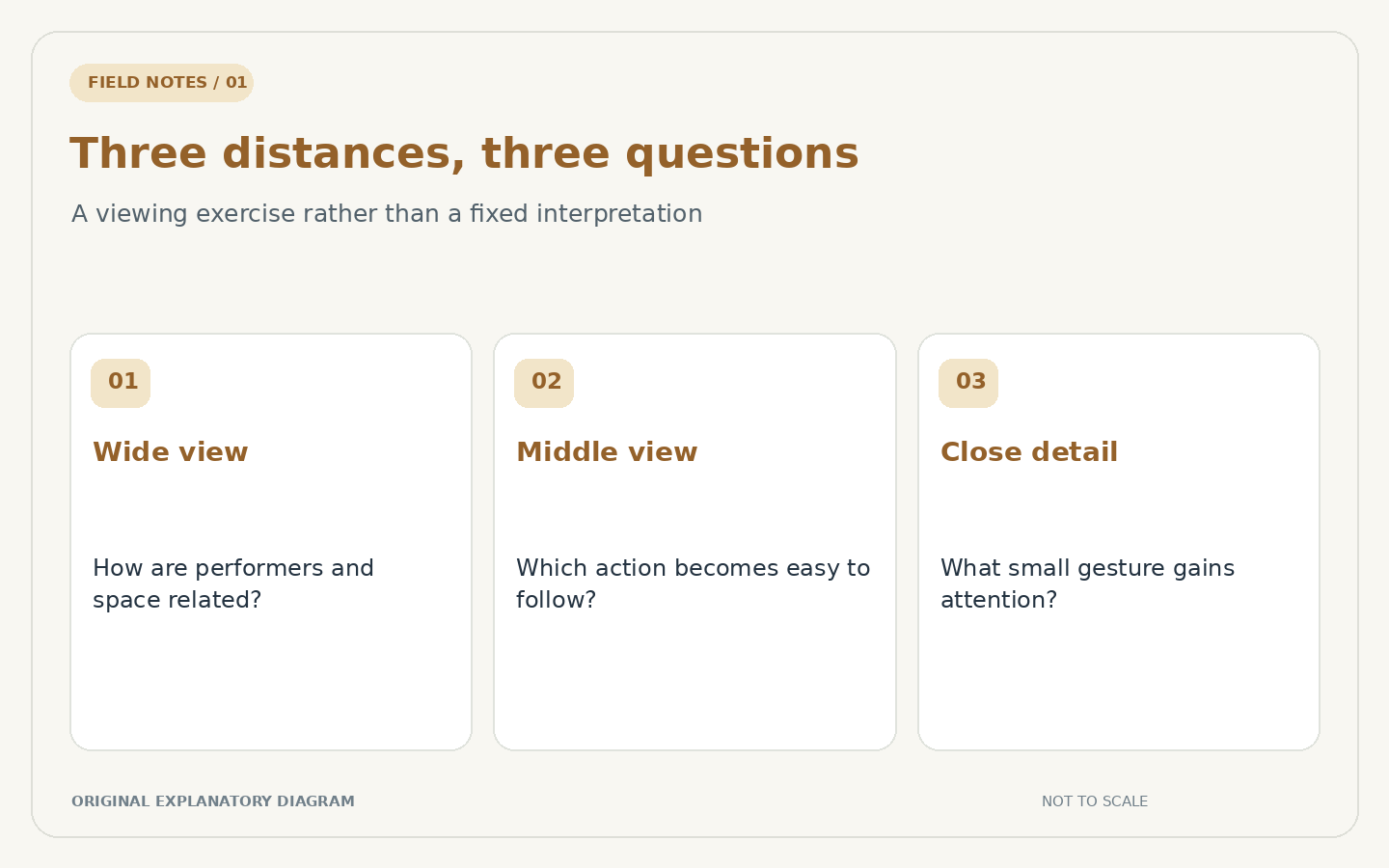
Compare distance with the information it gives
The British Film Institute’s Look Again teaching resource uses close observation of camera distance, composition, lighting and shot order to explore how moving images create meaning. Its approach invites viewers to investigate specific choices rather than attach a fixed emotional meaning to every camera angle. [2]
Try a simple comparison. In a distant view, notice relationships among bodies, instruments and empty space. In a closer view, notice a hand movement, expression or object that becomes easier to follow. Write what each view adds. A close shot is not automatically intimate, and a wide shot is not automatically impersonal; the surrounding sequence and your own attention help determine the effect.
Follow a handoff of attention
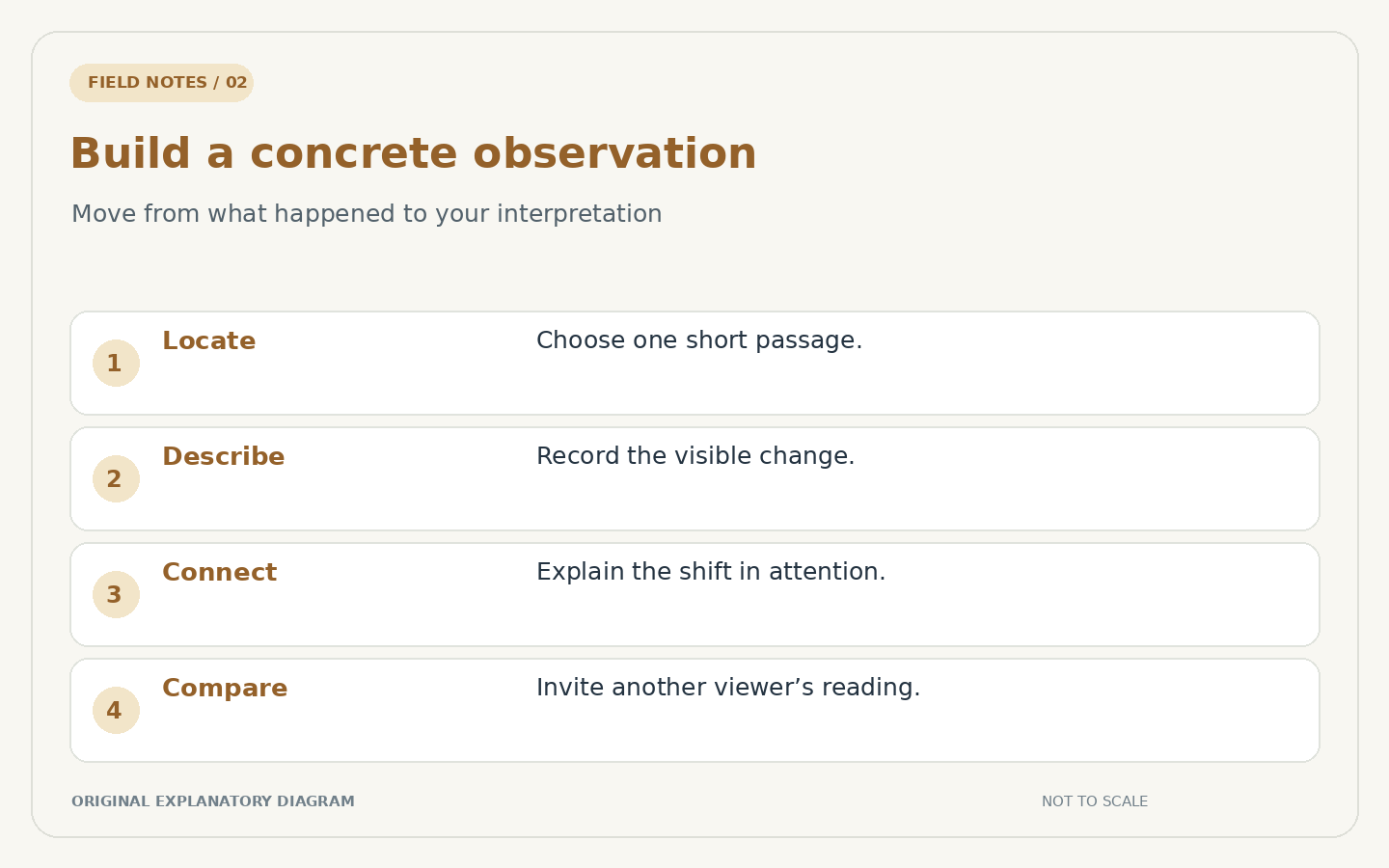
Look for a moment when the image moves from one performer to another. Ask what invited the change. Perhaps a new sound became prominent, a movement began, or a performer looked across the stage. You are identifying a possible relationship, not claiming to know what the editor intended.
Make a short note with three parts: what was visible before, what changed, and what became visible afterward. This keeps your description anchored to the sequence. If you write that a cut feels surprising, explain which expectation it interrupted. The exercise turns a broad reaction into something another viewer can examine, disagree with or notice differently on the next viewing.
A repeated musical passage offers another useful comparison. Notice whether the film returns to the same viewpoint or chooses a different one. You can describe the difference without deciding that one approach is better. Repetition gives your attention a reference point: something familiar in the sound meets something familiar or new in the image, and the relationship becomes easier to discuss.
Notice what remains outside the frame
A frame includes some things and leaves others elsewhere. When a singer looks offscreen, the unseen space can become interesting. You may wait for a reverse view or imagine a response. A microphone cable disappearing at the edge can also remind you that the performance extends beyond the selected rectangle.
Pause on an ordinary shot and describe its edges rather than its centre. Are other people partly visible? Does the composition allow movement into open space? Is an instrument cut off in a way that concentrates attention on playing? This is a useful exercise precisely because it has no required interpretation. It redirects your eyes toward choices you might otherwise overlook.
Hear what happens across a cut
A visual change and a musical change do not have to occur together. Choose a short sequence and notice whether the sound seems to continue while the viewpoint changes. Then describe the effect in everyday language: the room feels continuous, attention shifts within a phrase, or a new image makes a sound easier to identify.
Avoid treating a smooth soundtrack as proof that every image was recorded at the same instant. You may not have production information sufficient to establish that. For a viewing discussion, you can still explain the continuity you experience. Separate the visible and audible arrangement from questions about how the production assembled its materials. Both are interesting, but they are different questions.
Try a paper edit without changing the film
Draw three boxes representing shots you remember: a broad stage view, a close detail, and an audience response, for example. These are illustrative categories, not a claim about any particular sequence in Berlin. Write a sentence under each box stating what the image contributes. Now exchange the first and last boxes and imagine the difference.
Does the audience response now create an expectation instead of appearing to answer a performance? Does the detail seem mysterious before the wider view explains it? This miniature exercise can reveal how order contributes to meaning. Keep it on paper unless you have permission to reproduce or edit the source footage. The reasoning does not require a new video file.
Leave room for the audience
A reaction shot offers another person’s visible response, but it does not tell you exactly what they feel. Someone standing still might be absorbed, distracted or simply between movements. Describe the visible action before offering an interpretation. The same principle applies when discussing a performer’s expression or the atmosphere of a room.
In a group, compare two descriptions of the same shot. One viewer may notice collective energy, another an individual’s concentration. Ask which visual details support each reading. The goal is not to force agreement; it is to make the discussion more precise and generous. A concert film can hold several experiences together without providing a single emotional instruction for everyone watching.
Finish with one well-supported observation
After the exercise, write a short paragraph about one choice that stayed with you. Name the moment, describe the camera distance or edit, and explain what changed in your attention. Replace a general judgement such as great cinematography with a concrete observation that another viewer could locate.
Then return to the full performance. Close analysis works best when it enriches ordinary watching instead of replacing it. You now have several ways to notice the film’s construction: the space it establishes, the details it brings forward, the relationships created across cuts, and the things it leaves outside the frame. Those choices help make a concert film a distinct encounter with a performance.
Sources
- Berlin — Julian Schnabel
- Look Again: A Teaching Guide to Using Film and Television — British Film Institute, hosted by Screen Scotland